
Security, space and the Walbrook Club
On 16 June, Frances’s national cybersecurity agency ANSSI announced that it will not certify security products that lack quantum-resistant encryption from 2027. What it means in practice is that any company selling to state bodies will be shut out of the bidding for, say, infrastructure projects such as building data centres.
On 16 June, Frances’s national cybersecurity agency ANSSI announced that it will not certify security products that lack quantum-resistant encryption from 2027. What it means in practice is that any company selling to state bodies will be shut out of the bidding for, say, infrastructure projects such as building data centres.
A week later, President Trump signed an executive order, ‘Securing the nation against advanced cryptographic attacks’. It brings forward deadlines for government agencies to transition to quantum-secure communications: December 2030 for key encryption systems and December 2031 for other systems.
This is a wake-up call to other countries. The French and the Americans are right to accelerate regulation for three reasons.
First, there has been a constant stream of news this year about quantum computing advancements.
Second, adversaries are harvesting data now, with the aim of decrypting it later when quantum computers reach that capability.
Third, the cost of cyberattacks is escalating. For instance, a 2025 attack on vehicle manufacturer Jaguar Land Rover had a UK financial impact of £1.9bn and affected over 5,000 organisations, according to estimates from the Cyber Monitoring Centre.
Adversaries are harvesting data now, with the aim of decrypting it later when quantum computers reach that capabilityAON’s biennial authoritative ‘Global risk management survey’ (GRMS) risk register, published in October 2025, continues to place cyberattacks as the number one risk, with AI adoption accelerating exposure. The GRMS also notes that geopolitical volatility is, for the first time, seen as a top ten risk. That feeds into the fragility of cyber safety, as hostile state actors support criminal groups targeting companies and governments.
Our world is too digital-dependent to allow lax deadlines for adopting the armour of post-quantum cryptography. The clarion call from the French and the Americans should be heeded by all.
Space to growQuantum and cybersecurity are two of the UK’s industrial strategy priority technologies. The others are AI, semiconductors, engineering biology and advanced connectivity. Space seems an odd omission, given its relevance to all those mentioned.
The global space economy could grow to US$1.8tn by 2035 from US$630bn in 2023, notes a report from the World Economic Forum and McKinsey. It can help deal with Earth’s many issues.
Data centres with their vast energy use and high costs? Cheaper to run in space, with the added environmental benefit of space-based solar power. Other benefits: satellite upgrades in situ without the need to bring down the hardware, biomedical research which could speed up drug discovery for cancers, and detection of outbreaks of crop disease through improved satellite communication.
One of the world’s most valuable companies is SpaceX. Although founder Elon Musk’s personality – arguably too big for this planet – played a part in its market capitalisation reaching around US$2.43tn following its IPO, experienced venture capital and institutional funds also bought into the equity issue on 12 June. The valuation suggests investors see value beyond the hype.
“The rate of growth of the space industry has been propelled by exponential declines in the cost of access to space,” notes Rob Desborough, managing partner of Seraphim Space. “It has fallen by 100 times in the last decade, with a further potential 100 times fall projected over the next decade.”
The investment trust’s global Space Index reports a record US$8bn in investment deployed in Q1 2026, double the last quarter of 2025, a clear indication that state actors and private companies are doubling down on the sector.
The UK has, as in many technologies, been outstanding on the science front and in financing start-ups. However, it is lagging in scale-up capital, currently standing 23rd place in the world for average deal size in the space sector, due to the lack of Series A/B funding and further fundraising.
The solution is twofold. The government should add the space sector to its industrial strategy, thus ensuring policy drivers on tax relief and incentives are put in place. And institutional UK funds should step up their involvement in the sector through the Mansion House Accord, a voluntary agreement to invest in non-listed assets.
A club with characterRocket-like in its ascent is the Walbrook Club. Under the leadership of the Hon. Philip Palumbo, who took over from his father in 2018, membership numbers have risen to 650, all squeezed into a beautiful little Queen-Anne style brick house, sandwiched between a Wren church and modern, glass-abundant buildings like that of Bloomberg.
Guest speakers range from ambassadors to CEOs to politicians.
Many years ago, I overheard a conversation between two Conservative Party politicians in the bar area. One told the other she planned to “throw her hat in the ring” to be prime minister. She made it. Her companion became her chancellor. Liz Truss did not last long, nor did Kwasi Kwarteng.
Let us hope for some prime ministerial stability amidst yet another reshuffle at the top of UK government.
The Walbrook, unlike cryptography, the space sector and government, needs no improvement.
Introducing a new Review column by quantum expert Karina Robinson FCSI(Hon), exploring the worlds of technology, investment and innovation through a personal lens
You know quantum has reached the mainstream when ultra-fashionable Cannes, better known for its iconic film festival, joins the party. The inaugural World Quantum Cannes Festival has just been announced for late November.
This follows a home run for the sector in the past month. Three numbers sum it up:
The US government spent US$2bn on buying stakes in quantum companies, a vote of confidence in the industry.
Quantinuum, the merger of UK spin-out Cambridge Quantum and US entity Honeywell Quantum, just listed on Nasdaq at an unexpectedly high valuation of US$15.7bn.
Boston Consulting Group's report on the global quantum industry, highlighting technical breakthroughs and enterprise engagement, forecasts long-term value creation of up to US$850bn.
You know quantum has reached the mainstream when ultra-fashionable Cannes, better known for its iconic film festival, joins the party. The inaugural World Quantum Cannes Festival has just been announced for late November.
This follows a home run for the sector in the past month. Three numbers sum it up:
The US government spent US$2bn on buying stakes in quantum companies, a vote of confidence in the industry.
Quantinuum, the merger of UK spin-out Cambridge Quantum and US entity Honeywell Quantum, just listed on Nasdaq at an unexpectedly high valuation of US$15.7bn.
Boston Consulting Group's report on the global quantum industry, highlighting technical breakthroughs and enterprise engagement, forecasts long-term value creation of up to US$850bn.
What about the UK?
Despite the revolving door for prime ministers under the previous Conservative governments and, most likely, under Labour this year, UK governments have done a stellar job in creating a thriving quantum ecosphere. The UK stands in second place after the US for the number of private quantum companies and ranks third globally for the impact and quality of its academic research. This is all the more admirable considering the parlous state of the nation’s finances.
The successful recipe lies in productive collaboration between academia, the private sector and government. Over the past dozen years, spin-outs from world-class universities have found seed funding, quantum hubs have been created all over the country, conferences have sprouted, and the various governments have created and modified a national strategy.
The secret ingredient is Professor Sir Peter Knight, a quantum guru who has chaired the Strategic Advisory Board of the UK National Quantum Technologies Programme since its inception in 2014. From his base at Imperial College a dozen years ago, he spearheaded cooperation between the different sectors, combining a friendly demeanour with a powerful ability to build consensus.
The government, which announced a £2bn package for quantum innovation in March, estimates it could boost productivity by 7% in the next two decades and create over 100,000 jobs in the process. Currently, there are over 350 UK-based companies involved in the different quantum disciplines, from networking to computing to sensors.
What many of them need is scaling up capital, the main challenge in the UK and Europe for all companies involved in technology.
Scale-up capital
This brings me to Scale-Up Capital 2026, a recent event put on by the Worshipful Company of Entrepreneurs at the behest of Alderman Alastair King DL FCSI(Hon), former Lord Mayor of the City of London and currently Master of the livery company.
In the inspirational setting of the London Stock Exchange (LSE), 14 promising companies pitched to investors for scale-up finance. Did it work?
Yes, according to the founder and CEO of one of the companies involved, who told me, “The event was great. We got three new investors interested and one that already knew us reached out to catch up and potentially join the round.”
Initiatives like this are vitally important for the UK, which, as noted in a recent Review article, has “one of the world’s strongest seed-stage start-up hubs, but when it comes to scaling those companies, the system breaks down”.
The size of the problem is immense. The Entrepreneurs Network mentioned in its latest newsletter that although over £17bn was invested in innovative British companies, fewer than 600 raised Series A or B funding (around £3.8bn). In addition, only about 7% of seed-funded start-ups progressed to securing institutional scale-up capital. Heading abroad for funds should not be the only solution.
However, there are measures aplenty to try and solve the problem, from the government changing the tax rules on private investment in non-quoted companies, to the LSE transforming its listing rules, to the Mansion House Accord, which aims to channel institutional moneys to venture capital. What they all need is a sense of urgency.
The UK is a source of innovation
To the Barbican Centre, that monstrous example of brutalist architecture from the 1970s, for a reception hosted by its chair, Sir William Russell, Lord Mayor of the City of London 2019–2021, and board member Sir Nick Lyons, chair of Standard Life.
It is planning a major overhaul under new CEO Abigail Pogson. Whether its distinctive look, what one could call ‘brick, darkness & confusion’, can be transformed is not clear. What is clear is that the arts centre is already buzzing, packed with guests spanning all ages, there to see contemporary film, listen to classical music, wander through art exhibitions and munch in its many cafes and restaurants.
A summer musical with Ariana Grande, a star of song and screen, will pack in the Millennial generation. The current Cole Porter musical, High Society, is already attracting an older crowd (your correspondent included), won over by classic songs about trying to forget a past lover or wanting to be a millionaire, and the changing mores of socialite Tracy Lord.
Let us end with her best line: “The time to make up your mind is never.” It addresses the personal transformation of her ex-husband, who becomes her second husband. In the same way, for those who have written off the UK as a source of innovative, large-scale companies, think again.
The City Quantum and AI Summit 2025 Videos
All Videos recorded during The City Quantum & AI Summit 2025
Quantum Matters
This is an abbreviated version of my opening remarks to The City Quantum Summit, which took place at the Mansion House on October 11. A recording of the event is available here.
Thank you to all who have come in person – and virtually, from India to Bulgaria to Nigeria – for joining The City Quantum Summit. And thank you above all to our sponsors, who allow this Summit to be free, so all students can join, and Diversity & Inclusion can be central to it.
This is an abbreviated version of my opening remarks to The City Quantum and AI Summit, which took place at the Mansion House on October 11. A recording of the event is available here.
Thank you to all who have come in person – and virtually, from India to Bulgaria to Nigeria – for joining The City Quantum and AI Summit. And thank you above all to our sponsors, who allow this Summit to be free, so all students can join, and Diversity & Inclusion can be central to it.
We are celebrating the summit in the Mansion House, the palatial home of the Lord Mayor of the City of London, to bring together the financial and quantum sectors and thus leverage the heady advances we have seen in quantum over the last year.
However, quantum has limits. As you will all be aware, we in the UK have had a few issues with recent government announcements and policy, a plummeting pound, mortgage withdrawals, borrowing cost rises. In fact, Chancellor Kwasi Kwarteng rang me this morning. Karina, he said. Can a quantum computer solve these issues?
Sadly, not yet. But what can quantum do? It can help deal with a world of increasing complexity, geopolitical divisions, and environmental harm.
We don’t have a state of the art quantum computer today. But what we do have is different versions of a basic quantum computer – with a raft of improvements being announced every day – and advances in quantum software. That software can often be used on classical computers. Not just quantum ones. And participants should not let the perfect be the enemy of the good.
I won’t anticipate the panel discussions, but we are seeing developments in at least three areas of interest.
+the formation of new medicines, where you can create a ‘digital twin’ of a human body to conduct virtual drug trials.
+supply chain issues. A boring topic, till the pandemic and Ukraine brought it all home. For instance, optimising a supply chain, so that cargo ships are fully filled with the right containers and don’t sit around the Port of LA for weeks on end. Not sexy, but with an incredible effect on the bottom line of the companies involved, and on the carbon footprint of humankind.
+Finance. Given the roller coaster of all markets, who wouldn’t want to de-risk portfolios, price options infinitely better, hedge forex risk properly…
Why are we here? The City, and the quantum sector together, can create the economic growth that governments in the UK, the US, and Europe, and other countries, are looking for. How?
Communication, collaboration, immigration.
Communication.
The quantum sector needs to communicate better with the financial sector, and the wider world. The City Quantum and AI Summit is one of the foundations of that.
Collaboration.
The more we do together, the better for quantum, the better for the financial and professional services industry. And the more transnational that is, the better. I note the UK and the US Technology Partnership, announced last year, and which will hopefully include other countries, was just updated last week. In the words of Jay Lowell of Boeing: “The economy of ideas does not follow geopolitical borders.”
Immigration.
We need to get real on this. We – and I mean ALL the industries represented here, don’t just need quantum PhDs, we need marketing people, we need HR, we need PR. In the FT yesterday, President Obama’s Chair of the US Council of Economic Advisers, Jason Furman, noted that immigration is so much more important than any other measure to increase productivity.
Communication, Collaboration, Immigration.
In the last three weeks, we’ve seen the Nobel Prize for Physics given to three pioneers of the quantum industry.
We’ve seen the European Commission announce six sites where quantum computers will be located in the EU.
We’ve seen the creation of UKQuantum, a consortium to accelerate UK innovation.
That is just three announcements in the sector. Even more important is the increase in defence budgets on the back of our uncertain world. Money matters. As we saw from the Apollo Space Mission, defence spending can be a propulsor of amazing innovation for civilian use. In fact, space missions brought us CAT scans, water purification systems, and even Baby Formula!
There is, as The Quantum Insider puts it, a fundamental discrepancy between the rapid advances in quantum technology and the adoption by commercial customers. But today, you are going to here from those who are adopting it. Those like Bosch, Standard Chartered, and Boeing, who are going to have a quantum advantage in competing in our disrupted world.
US General Eric Shinseki had a great phrase: “If you don’t like change, you’re going to like irrelevance even less.”
Let’s get on with being relevant. Thank you.
Karina Robinson is the Founder of The City Quantum and AI Summit and a Senior Advisor to Multiverse Computing

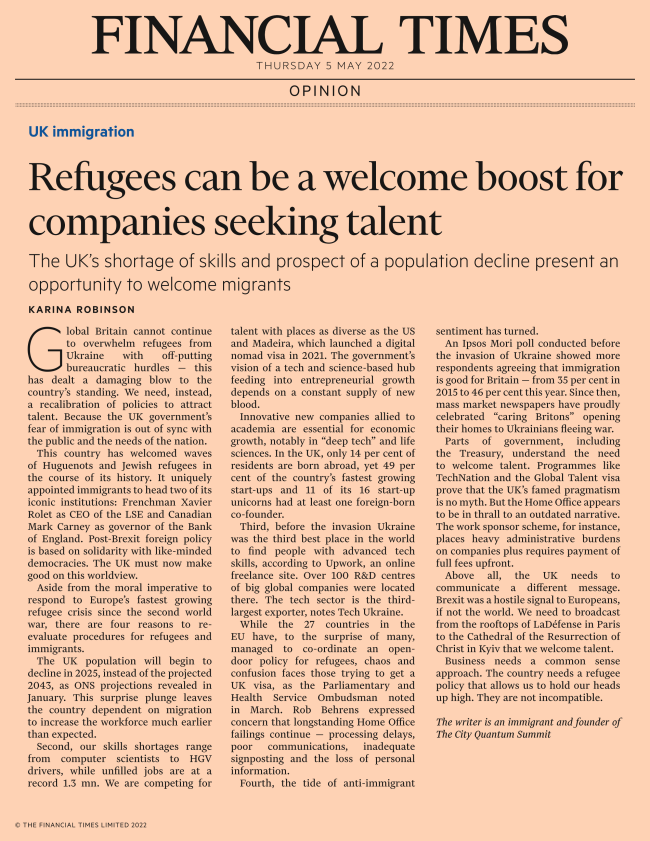
Refugees can be a welcome boost for companies seeking talent
Global Britain cannot continue to overwhelm refugees from Ukraine with off-putting bureaucratic hurdles - this has dealt a damaging blow to the country’s standing. We need, instead, a recalibration of policies to attract talent. Because of UK government’s fear of immigration is out of sync with the public and the needs of the nation.

Speech at the Mansion House
Welcome all to the Annual Banquet of the WCIB and welcome to the Mansion House, the Heart of the City.
The Mansion House reminds me of the Villa Farnesina in Rome, built for Agostino Chigi, a banker who was treasurer to the Papal States in 1510 and a patron of great artists. He entertained his clients – Popes, Ambassadors, men of power – in such style that he was known as ‘the Magnificent’.
I should hope we have entertained you in such style today, that you too will say the International Bankers are Magnificent!
At one banquet, in an extravagant gesture, the silver dishes were thrown into the Tiber River after use. I therefore ask you to pick up any silver left on your tables and we shall throw it into the Thames. Or perhaps not!
Immigration is key to attract global talent
This is an abridged version of a speech given to a Mansion House packed to the rafters with 350 members of the International Bankers and their friends.
My year as Master (Chair) runs till October 2020.
Welcome all to the Annual Banquet of the WCIB and welcome to the Mansion House, the Heart of the City.
The Mansion House reminds me of the Villa Farnesina in Rome, built for Agostino Chigi, a banker who was treasurer to the Papal States in 1510 and a patron of great artists. He entertained his clients – Popes, Ambassadors, men of power – in such style that he was known as ‘the Magnificent’.
I should hope we have entertained you in such style today, that you too will say the International Bankers are Magnificent!
At one banquet, in an extravagant gesture, the silver dishes were thrown into the Tiber River after use. I therefore ask you to pick up any silver left on your tables and we shall throw it into the Thames. Or perhaps not!
Rumour has it that il Magnifico’s servants had placed invisible nets in the river, and thus recovered the silver.
Banking, and financial services in general, is about covering your risk. As he did.
The City faces many risks. Today, I want to concentrate on one risk only. Arguably the most crucial one. The war for talent.
Mark Hoban, a former City Minister - who is present tonight - chairs the Financial Services Skills Taskforce, which published a damning report last month on the City’s talent recruitment and retention. I quote: “There is no doubt that the financial services sector is facing an existential skills crisis.”
The demand for talent already exceeds supply and this trend is set to become more acute. Additionally, “The lack of gender and ethnic diversity is both a social issue and a skills issue. Talent that the industry needs is not being utilised.”
This is the reason why Professor Grace Lordan from the London School of Economics – also here tonight - and I are co-founding The Inclusion Institute at the LSE. The Institute arose out of a report commissioned by the International Bankers. In partnership with City companies, the Institute will use behavioural science and data to lead to more diverse talent recruitment and retention, to dynamism and creativity, and to changing culture for future success.
Cognitive diversity is necessary to deliver better company returns in a transformed digital marketplace. How does this innovation happen? It is most likely to occur when you mix gender, generation, ethnicity, sexual orientation and nationality, on your boards and in your teams. And ensure they feel accepted, or included, and thus able to speak up.
The City is working hard on its D&I. Yet it is already a world leader in one form of diversity. Nationality. We have a wider mix and more nationalities in the City than in any other major financial centre. 40% - that is four zero – of City workers are foreign-born – and they are fully included.
What other country would have a Canadian leading its central bank, a Frenchman till recently leading its stock exchange, and an American woman, leading one of its main financial derivative companies, IG? Plus, at a much lower level, voting in another foreigner – me - as Master of the Worshipful Company of International Bankers. I am grateful!
But the City’s USP is under threat. The government’s recently announced, hard core policy on immigration is undermining the City’s search for talent. They should care, because we bring in over 10% of tax revenues.
We would not have the strongest Fintech sector in the world, without the Open Door, Open City policy of earlier governments. We wouldn’t be leaders in Green Finance without that Open Door, Open City policy. Note that the UK Green Bond market is already worth $44 billion. There is so much more that we in the City need to do to help finance the environmental transition for our planet’s survival.
For that, we need the best talent in the world.
There are at least three things wrong with the new system.
In the first place, an immigration policy that gives way too much importance to higher education, such as PhDs, cannot be right. Skills are of as much importance as a university degree in our disrupted world. The Russian founder of Revolut, a City-born start-up which was just given a valuation of $5.5 billion dollars, doesn’t have a PhD. Let alone the Richard Branson’s of this world. Or even the Mark Zuckerberg’s.
Secondly, an immigration policy that harks back to an era of central planning cannot be right. Five-year plans surely went out with Stalin?!. Yet a Tory government believes in the future it will be able to figure out where the skills shortages are in the economy and make short term changes to policy to fill them. That’s in a world where we don’t even know what many of the jobs of tomorrow will look like.
And finally, an immigration policy which will only allow large, well-capitalised firms to import foreign workers, is not right. The cost and bureaucracy of work permits is such that SMEs, start ups and the like won’t be able to afford them – and they are the accelerator in the economy.
Let my last quote be from Catherine McGuinness, the CEO of the City: “We need an immigration system that works for the whole of the financial services ecosystem. This includes those supporting industries which keep the City ticking and we look forward to engaging with the Government on this particular issue.”
I am not sure she meant that last line…
The City understands that this government has an obligation to those who voted it in, a number of whom believe that immigration – rather than globalisation and automation - is to blame for inequality and the precariousness of modern jobs. But Boris Johnson’s government has a duty to destroy myths about immigration and a duty to care for the City, let alone the whole economy. Our tax revenues and our inventiveness will help in financing a better future for all.
The City is a British jewel, a European jewel, and a world jewel – in fact, it is a public good and I would ask that you join with me, in any way you can, in pressing this government to change its policy, and return to an Open Door, Open City.