
In an Age of Deep Tech, The City Summit Bets on Human Connections
Insider Brief
The sixth annual City Quantum & AI Summit will bring leaders from technology, defense, finance, government and research to London’s Mansion House on Oct. 7.
The program will examine quantum and AI applications and risks across cybersecurity, finance, life sciences, space and national security.
The summit will emphasize plain-language discussions, cross-sector networking and governance for technologies developing faster than existing institutions and regulations
The technologies changing defense, medicine and finance are advancing faster than the institutions expected to manage them. Getting the right people in the same room is a critical step toward optimizing the good that these technologies can do, while minimizing potential adverse effects.
Insider Brief
The sixth annual City Quantum & AI Summit will bring leaders from technology, defense, finance, government and research to London’s Mansion House on Oct. 7.
The program will examine quantum and AI applications and risks across cybersecurity, finance, life sciences, space and national security.
The summit will emphasize plain-language discussions, cross-sector networking and governance for technologies developing faster than existing institutions and regulations.
Images: Paulina Roots Photography
The technologies changing defense, medicine and finance are advancing faster than the institutions expected to manage them. Getting the right people in the same room is a critical step toward optimizing the good that these technologies can do, while minimizing potential adverse effects.
The sixth annual City Quantum & AI Summit is aimed at bringing those people – military leaders, technology executives, researchers, investors and policymakers – to the Mansion House in London on Oct. 7. The one-day event is organized around the theme “Connections in Chaos.”
Karina Robinson, CEO of Redcliffe Advisory and founder of the summit, said the theme reflects a loss of predictability in international affairs, compounded by the rapid development of artificial intelligence and the emerging possibilities of quantum technology.
“The modicum of predictability that existed in world affairs a decade ago has vanished,” said Robinson. “How to cope? Develop personal connections. The Summit’s focus has always been to create networks across countries and across sectors. It is the best source of innovation and, in our age of AI, the last refuge of humanity.”
The summit’s program treats those human connections as practical infrastructure. It brings together industries that face related technological and security challenges but often operate separately. Defense officials will meet quantum and AI executives. Medical researchers will discuss computing with technology specialists. Investors and financial executives will examine how companies can move from research to commercial deployment.
According to Robinson, the objective of the summit is not simply to present new technology, but also help decision-makers understand how quantum and AI could affect their organizations, even if they lack scientific or engineering backgrounds.
Defense Beyond the Battlefield
Defense will open the program, reflecting the growing role of advanced computing in national security.
A panel titled “Safety and Security in Troubled Times” will be chaired by Admiral Sir Tony Radakin, former chief of the Defence Staff. Scheduled participants include Enrique Lizaso, co-founder and CEO of Multiverse Computing; Tony Lowe, CEO of quantum-sensing company Delta.g; Jeanette van Halteren, Managing Consultant at Thales; and Dr Ben Tallis, Head of Policy & Analysis at defense technology company Helsing.
The discussion will extend beyond weapons and conventional military operations to threats against digital infrastructure. Cyberattacks can disrupt communications, financial services, energy networks and public agencies without crossing a physical border.
“Defence is a clear example of the Summit’s theme,” said Robinson. “The panel is entitled Safety and Security in Troubled Times because we aren’t just talking about tanks and drones and territory, but about defending ourselves from cybersecurity attacks which can bring society to a standstill. We also have a Qnote from NATO’s Assistant Secretary General, Jean-Charles Ellerman Kingombe. The death of NATO has been much spoken of lately. It is still alive and kicking, and an indication that organisations to connect countries have value.”
Quantum computing adds urgency to the cybersecurity discussion. Large, sufficiently capable quantum computers could eventually defeat several forms of encryption now used to protect government, corporate and personal information. Governments and businesses are therefore beginning to adopt post-quantum cryptography, a new class of security methods designed to withstand attacks from both conventional and quantum computers.
AI presents a more immediate set of opportunities and risks. Defense organizations are already exploring its use in intelligence analysis, logistics, cybersecurity and planning. The same tools can also make cyberattacks faster and more difficult to detect.
Ellerman Kingombe, NATO’s assistant secretary general for innovation, hybrid and cyber, is scheduled to deliver an address on cyber defense in the quantum and AI era. The appearance continues a longstanding relationship between the summit and NATO.
Credit: Paulina Roots Photography
Connecting Science With Capital
The program will also examine whether financial markets and institutions can provide the patient capital required by quantum and other deep-technology companies.
These businesses often face a difficult path to market. They may need years of research, specialized equipment and highly trained workers before producing meaningful revenue. That model does not always fit the short development cycles associated with conventional software startups.
Dame Julia Hoggett, chief executive of the London Stock Exchange, and Emily Turner, CEO of HSBC Innovation Bank UK, are scheduled to take part in a panel on financing innovation. U.S. venture investors are also expected to participate.
The session will consider how banks, venture firms and public markets can support companies as they progress from scientific research to products and commercial operations. It also places finance within the summit’s wider theme. Scientists may develop the technology, but investors, corporate customers and public institutions determine whether it can reach the market at scale.
Robinson said identifying companies early has helped sustain the summit over six years. Previous programs featured executives from Oxford Quantum Circuits, Nu Quantum and Multiverse Computing when the companies were considerably smaller.
The setting – the Mansion House, the official residence of the Lord Mayor of London – adds another connection between old and new forms of commerce. It has long served as a center for business and civic events.
“The Mansion House is a palace with glittering chandeliers and vast columns,” said Robinson. “Over the centuries it has been a centre of commerce and deal-making. It provides a unique and contrasting backdrop to frontier technology.”
The summit will open with remarks from Alderman Bronek Masojada, who is expected to become Lord Mayor, followed by Robinson.
From Life Sciences to Space
Robinson pointed to life sciences and space as two areas where the summit will emphasize the constructive uses of AI and quantum technology.
“I am hugely looking forward to the Space panel, in association with Farnborough International Airshow,” said Robinson. “Their CEO, Gareth Rogers, will chair it. There will certainly be positive news from the panellists about their advances. The other panel that will focus on positive disruption is the Life Sciences one. Here the intersection of Quantum and AI will figure prominently.”
The life sciences panel will include Dr. Lara Jehi, chief research information officer at Cleveland Clinic; Sergii Strelchuk, Lead Researcher on quantum at Wellcome Sanger Institute; and Anthony Rowe, vice president of Onyx Research at GSK.
AI is already used to analyze medical information, identify patterns in biological data and assist researchers searching for drug candidates. Future quantum computers could add new tools for simulating molecules and chemical reactions, although the systems available today remain limited.
Ashley Fieglein Johnson, president and chief financial officer of Planet; Will Whitehorn, chair of Seraphim Space Investment Trust; and Phil Cooper, commercial lead for aerospace, satellite and defense at Amazon Web Services, are scheduled to participate in the space panel.
It will be chaired by Gareth Rogers, CEO of Farnborough International Airshow, one of the biggest trade shows in the world, which brings together defence and aerospace every two years.
The discussion is expected to examine the growing connections among satellites, cloud computing and AI. Spacecraft generate large amounts of information that must be processed, transmitted and converted into useful observations for businesses and governments.
Another featured session, called “Entangled Exchange,” will bring together Gerald Mullally, CEO of Oxford Quantum Circuits, and Nic Harrigan, quantum manager at Nvidia. The conversation will explore the relationship between quantum computing and AI.
AI is increasingly being used to design, calibrate and operate quantum hardware. Researchers are also investigating whether future quantum systems could assist with selected AI, simulation and optimization tasks. The two technologies are therefore developing as parts of a broader computing system rather than as isolated fields.
Plain English for Complex Technology
Making those subjects accessible remains a central part of the summit’s approach, Robinson said. Its intended audience includes board members, investors, bankers and defense executives who need to understand the business and strategic implications without receiving a technical lecture.
“‘No lingo, no jargon, plain English only,’ is our strap line,” said Robinson. “We set up the Summit to engage the non-technological, non-scientific public in the exciting – and at times scary – developments in Quantum & AI. Board members, non-tecchie investors, bankers and defence executives all appreciate the event as a way to understand at a macro level technologies that are relevant to their organisations or could be interesting investment opportunities. Words like entanglement, superposition or inference are prohibited on pain of death!”
The program will include a special reception with Sir Peter Knight, an influential figure in the development of the United Kingdom’s quantum research program. Robinson said the reception will recognize his contribution to the country’s position in quantum science.
Governance and ethics will also form part of the event. An invitation-only dinner sponsored by Clifford Chance will feature a discussion between Roman Orús, co-founder and chief scientific officer of Multiverse Computing and a member of the United Nations Independent Scientific Panel on AI, and Thore Graepel, a machine-learning professor at University College London and former distinguished research scientist at Google DeepMind.
Jonathan Kewley, chair of Clifford Chance’s global tech group, will moderate this conversation, examining how institutions can develop ethical and governance systems for technologies whose capabilities are evolving more quickly than many existing rules.
“One of our past sponsors said the Summit combined ‘a super power-networking platform and a vital source of information exchange on the mega-trends of our time’. We are well set to repeat the winning formula this year!” said Robinson.
To register, please click here.
Global lessons from a Spanish start-up
In July, the Spanish AI/quantum firm Multiverse Computing became a European unicorn. It announced it had almost closed its €500m funding round, which would value it at around €2bn post-money.
When I joined as its senior adviser in April 2022, the firm had only 30 employees and two locations: its headquarters in San Sebastian and an office in Toronto, Canada, whose first client was the Bank of Canada.
With more than 400 staff representing over 45 nationalities and operations in more than ten locations, including San Francisco and Qatar, what lessons can start-ups glean from the firm’s trajectory?
In July, the Spanish AI/quantum firm Multiverse Computing became a European unicorn. It announced it had almost closed its €500m funding round, which would value it at around €2bn post-money.
When I joined as its senior adviser in April 2022, the firm had only 30 employees and two locations: its headquarters in San Sebastian and an office in Toronto, Canada, whose first client was the Bank of Canada.
With more than 400 staff representing over 45 nationalities and operations in more than ten locations, including San Francisco and Qatar, what lessons can start-ups glean from the firm’s trajectory?
Government support
The Basque city, best known for its culinary scene, was not an obvious place to establish a frontier technology firm. Enrique Lizaso, the co-founder and CEO told me he attributes it to the San Sebastian city council and the Basque government’s vision and political will in courting the start-up in its early days to coax it to begin its corporate journey in San Sebastian.
“They understood that the Basque Country needed a competitive new industry to be based there. They took a serious risk on small companies – they bet resources on firms that might fail,” he said.
In the ensuing years, the government’s business-friendly policies and its ability to react quickly to the demands of deep technology companies kept the firm anchored in the Basque Country.
Now, in 2026, a northern region of Spain with a population of only 2.2 million hosts a thriving quantum, AI and biotech community, its strength reflected in IBM’s decision to install its most advanced quantum computer in San Sebastian rather than in a larger city like Barcelona.
Flexibility is a must
Clad in his signature waistcoat, jacket and bowtie, Lizaso warned startups against focusing on a particular solution – flexibility is a must – and says it is key to “pay attention to what is happening around you”.
Multiverse Computing began its journey concentrating on quantum algorithms for finance. Its commercial mindset led it to ask customers what they needed – something that many start-ups led by academics fail to do – while figuring out how this would fit with the wave of AI sweeping the world.
The consequence was technology born out of quantum and AI that can compress large language models (LLMs), reducing the computing resources needed to run them.
It is a solution to one of the biggest problems facing the world: the massive energy use and cost of LLMs. Already in 2024, data centres consumed more energy than the entire annual electricity of the UK, according to the International Energy Agency (IEA). The institution expects that to double by 2030.
Consider contingencies
Multiverse is concentrating on the demand for energy-efficient solutions that can continue operating in military or political conflict. This means enabling AI ‘on the edge’. “No one thinks of using a mobile phone without AI, but it can’t be on the cloud [for security and cost reasons],” said Lizaso.
Companies are becoming more aware of the possibility of both Wi-Fi and access to the cloud being cut off, either by an enemy or, potentially, by an executive order from the US government. Most major cloud providers are American.
Consider complementary skills
Lizaso also advises startups to ensure their founders have different talents. Lizaso’s background is in banking and medicine, while his co-founders bring expertise in areas including quantum computing, technology, marketing and entrepreneurship.
The four founders worked together for a couple of years before starting Multiverse Computing, another important component on the human side, and “we have fun together [outside the office]”, said Lizaso.
Consider culture
That is where San Sebastian’s reputation for great food comes in. It has the highest concentration of Michelin-starred restaurants per capita in the world, plus mouth-watering local pintxos bars. All four founders share a love of good food and good wine. Yet another reason to maintain Multiverse Computing’s headquarters in the seaside city, and for quantum-AI start-ups to be open to surprising locations.
Can teaching social skills improve social mobility?
The Cambridge Business Dictionary defines “small talk” as “polite conversation about things that are not important.” What this does not tell you is that it is a learnable skill, and the key to unlocking the door to professional advancement.
At a meeting on social mobility hosted by the Lord Mayor’s Appeal, the boss of an investment firm said about discussing art, philosophy and books that she hadn’t read, “I was smart enough to do the job but lost my voice in those conversations.”
Social mobility has stalled in America and Britain. And since the COVID-19 pandemic many young people face new disadvantages hindering their educational and professional prospects. Could social skills be the key to improving their opportunities, and kickstarting social mobility? Karina Robinson looks at the arguments for businesses and governments investing in how we interact with each other.
The Cambridge Business Dictionary defines “small talk” as “polite conversation about things that are not important.” What this does not tell you is that it is a learnable skill, and the key to unlocking the door to professional advancement.
At a meeting on social mobility hosted by the Lord Mayor’s Appeal, the boss of an investment firm said about discussing art, philosophy and books that she hadn’t read, “I was smart enough to do the job but lost my voice in those conversations.”
Nicole Williams wasn’t intimidated by the legal knowledge and intelligence necessary for the high-powered job she held. She, and many others, are intimidated by the social prerequisites and what she called the ‘’unspoken rules of the City.”
It is time to put social skills front and centre in all social mobility policies. Not least because low economic growth, the COVID-19 pandemic and artificial intelligence (AI) are leading to ever worse outcomes for those from disadvantaged backgrounds.
Social mobility is getting worse
According to Britain’s Department for Education the latest results of GCSEs, the exams at the end of secondary schools in England and Wales, show a disadvantage gap index at 3.92. The index, which tracks the difference in educational outcomes for those from different backgrounds, is close to the highest it has been in a decade. It had previously dropped to a low of 3.66 in 2019 and 2020. The pandemic and lack of school funding then set it on an upward trend.
The freezing of social mobility extends beyond Britain. According to Opportunity Insights, 90 per cent of Americans born in 1940 earned more than their parents but children born in the mid-1980s only have a 50 per cent chance of doing so.
Opportunity Insights promotes policy changes to revive the “American dream” of social mobility, such as subsidised housing vouchers to help parents move neighbourhoods. But while their experiment was successful, such interventions are too expensive for governments to fund on a large scale.
AI is set to exacerbate social inequality. AI-driven productivity boosts are likely to be skewed towards high-income rather than lower-wage workers, argues Sam Manning of the Brookings Institution, and AI-driven automation could increase the share of income going to capital at the expense of labour. What does this mean? That the wealthier in society will benefit from the productivity gains, while the poorer will lose out.
Additionally, large language models learn from existing data, worsening biases in models that are being used ever more widely for credit decisions and recruitment.
How social skills can improve social mobility
The British government’s Schools White Paper, published in February, aims to halve the attainment gap between disadvantaged children and their peers over the next decade.
Speaking about the planned reforms Bridget Phillipson, the education secretary, called them “a golden opportunity to cut the link between background and success”. But the reality is not so simple.
Governments and charity programmes aiming to boost social mobility do have an impact. And companies aiming to increase the social diversity of their workforce are told to create wider hiring paths, internal social mobility networks and extra training in hard skills. A report by The Inclusion Initiative at LSE, in association with bank HSBC and Progress Together, a social mobility charity, created a five-point blueprint to change management behaviour. These include making unwritten rules explicit, reviewing any biases in advancement opportunities and making a concerted effort to ensure diverse voices are heard in meetings.
But none of these interventions focus on a realistic solution to the biggest issue in social mobility at work: networking is as important as school, apprenticeship or professional qualifications.
Grace Lordan of The Inclusion Initiative notes that workers from lower socio-economic backgrounds often lack “web of contacts”, such as networks and mentors, that help others advance. She calls for companies and schools to explicitly teach these soft skills to all colleagues and students – from small talk to approaching senior colleagues – to level the playing field.
Lifelong learning at work is a necessity in our accelerated world
Businesses are generally eager for their staff to take courses ranging from AI to compliance. It is time to add networking to the mix.
Training in social skills is not the equivalent of denying a social background. Instead, it teaches how to change the subject to an area of mutual interest, how to approach a senior figure in the workplace and how to build your network.
Jon Hammant, who ran a $6 billion business for Amazon Web Services, described a time when, during a meeting at a consulting firm, “the other managing directors were discussing their weekend grouse shooting plans. Growing up in social housing, the only shootings I’d ever heard about were of a very different kind. That cultural gap doesn’t close on its own – we need to teach people how to navigate the room, not just hope they figure it out.”
Why is teaching social skills important?
Education in social skills is not new. John D. Rockefeller claimed that the ability to deal with people is “as purchasable a commodity as sugar or coffee” and hugely valuable. And for hundreds of years finishing schools taught upper class girls how to behave in social situations.
But the training that I am suggesting will help others, such as pandemic-era students whose communication skills, whatever their background, are underdeveloped; the shy; and those with mild autism. Bill Gates credits his sociable mother with forcing her withdrawn, geeky son to interact with adults, a skill that proved invaluable in his interaction with powerful individuals, ultimately leading to the creation of one of the most valuable companies in the world.
So an added benefit to the training will be transitioning from fear to finding enjoyment in social occasions that are intrinsic to a career and, just as much, to life.
Lessons for the workforce from the oldest person in the room
In a low growth, low productivity, low birth rate era, with the pensions time bomb ticking away, keeping people working longer is crucial. And that person could well be you, for one day you glance up from your iPhone and you are the oldest person in the room. A deliberate exercise regime and good genes are not enough to spare you. On the other hand, everyone assumes a wisdom born of experience. What should companies do to adapt, include and innovate?
In a low-growth, low-productivity, low-birth rate era, with the pensions time bomb ticking away, keeping people working longer is crucial. But older workers are often overlooked for recruitment or promotion due to prejudice and ageism. Karina Robinson writes about her own experience and says that the problem risks getting worse, as more than half of today’s 5-year-olds in developed economies will live to at least 100.
One day you glance up from your iPhone and you are the oldest person in the room. Dyed hair, a deliberate exercise regime and good genes are not enough to spare you. Gravity may now be your constant companion but there is a delight to being older than the CEO, the head of sales, the head of growth and all the other titles spread like confetti. Everyone assumes a wisdom born of experience.
At a recent two-day retreat with Multiverse Computing, a company whose board I advise, colleagues in their early 30s, and even middle-aged ones, sidled up to ask for career advice or how to deal with internal political concerns. The reading glasses I now must wear may be a pain, but they are also a useful accessory to fidget with while considering the dilemmas of employees at a quantum software firm.
The liberation from ego is not fully accomplished – presumably that Buddhist goal only happens when we are dead – but what the French call ‘je m’en foutisme’, which can be loosely translated as ‘I couldn’t give a damn’, is certainly prevalent. At a London School of Economics alumni gathering, having been given the post-lunch slot for a keynote, I figured there was only one way to wake up the audience: perform a haka like the New Zealand All Blacks. All 5 feet 2 inches of me (1.6 metres) did so; only one Argentine alumnus was able to identify my wild manoeuvrings on stage; no one slept through my speech.
The absurdity of the human condition, of our petty ambitions in a vast universe, come home to roost, as mortality feels more and more like a reality, rather than a distant dream. Making a fool of yourself becomes increasingly irrelevant in the grand scheme of things – good training for a non-executive director in asking the question that no one else dares bring up, or one that may, actually, turn out to be foolish. But one stupid question does not negate a long career.
Women over 50 are the fastest growing segment of the UK workforce, while globally in 2021 this group equalled 26% of all women, up from 22% a decade earlier, according to the World Health Organisation (WHO). They are often overlooked for recruitment or promotion due to prejudice and ageism. Yet the problem also extends to ageing men, and it will only become worse. In the wealthiest nations, experts predict that more than half of today’s 5-year-olds will live to at least 100.
In a low growth, low productivity, low birth rate era, with the pensions time bomb ticking away, keeping people working longer is crucial. Britt Harris, CEO of the US’s largest endowment fund, recently told the FT that ageing executives should ‘move out of the way’ for younger generations. But the leader of the University of Texas and Texas A&M endowment system is missing a trick.
What we need is more people over 60 staying in work, not least because age diversity directly benefits performance via enriched knowledge, skills and social networks. At the LSE’s The Inclusion Initiative (TII), we’ve been considering how the workplace needs to change to attract and accommodate the older worker.
Rather than thinking only about “age-specific steps”, employers need to focus on benefits that accrue to all, but may be especially relevant to older workers, such as more flexibility and more training at work. The policies aimed at those with disabilities, like wellness programmes and meeting protocols (for example, making slides available before meetings) have benefited all employees, notes TII Researcher Daniel Jolles. Age-inclusive HR policies create more inclusive policies for all workers.
The ‘Great Retirement’ of 50+-year-olds saw the UK and other developed countries lose their older workforce post pandemic. In the UK, this movement has not been reversed and is a key factor in the worker shortage holding back the economy. According to think tank Phoenix Insights, 16 per cent of 50 to 64-year-olds that have left work since 2019 blame long-term sickness or disability for being economically inactive. Here, better provision of health support for long-term conditions is crucial, albeit unrealistic given the state of the NHS in the UK and of the straining health systems of other countries.
Meanwhile, 57 per cent of those in their late 50s say they are not looking for work because they are retired or looking after family. This rises to 68 per cent among those in their early 60s. My generation is burdened with taking care of ageing parents in their 80s and 90s, as older life is extended but with its consequent mental and physical vulnerabilities, while also increasingly taking care of grandchildren due to the astronomical cost of childcare and the two-working-parent family. “Employers urgently need to get serious about offering flexible working that fits alongside other pressures and priorities in people’s lives,” notes Catherine Foot, Director of Phoenix Insights.
One way for employers to tempt older workers back is through signing up to the Centre for Ageing Better’s Age-Friendly Employer Pledge. Signing the Age Pledge signals that the unique needs of an older workforce will be catered to – even if some of them are not dissimilar to those of other groups. When a firm celebrates Pride Month in June it is sending a signal to LGBT+ employees and potential employees that their unique needs will be catered to. It is not an onerous pledge. Measures include identifying a senior sponsor for age-inclusion, ensuring age is specifically named within Equality, Diversity and Inclusion policies, encouraging career development at all ages, and hiring age-positively.
An article in the Harvard Business Review focused on how multi-generational teams “bring together people with complementary abilities, skills, information and networks.” Given that we currently have a mind-boggling five generations in the workforce, this is not without age-related misconceptions and conflict, which need to be handled. But the interaction can be a game-changer. The article gives the example of the development of the first low-cost open-source metal 3D printer by the Open Sustainability Technology Lab at Michigan Technological University. Former director Joshua Pearce credits the team’s success to members’ willingness to learn from those of other generations, including “the technical skills of Gen X faculty, the software wizardry of Millennial graduate students, and the experienced resourcefulness of Boomer researchers.”
Seventy-six-year-old Elton John hobbled onto the stage at the Glastonbury music festival in June. As the aerial cameras panned over the crowd – so large it caused a Twitter storm – every young person, as well as the middle aged, sang along to 1970 hits like ‘Candle in the Wind.’ Most appropriate though, was ‘I’m still standing’, which he played from a sitting position.
Why the Benefits of Age Diversity Need to be Shouted from the Rooftops
Age has been in the news.
In the UK, we just celebrated the Platinum Jubilee of our queen, now 96-years old, and still delivering value in the workplace. In her case, that happens to be the balcony on Buckingham Palace.
In the US we have the oldest man to be sworn in as President at age 78. At age 29, Joe Biden was one of the youngest people ever elected to the United States Senate. He may be domestically unpopular - hugely unpopular – but I am not alone in being grateful that an experienced statesman is in charge during the biggest crisis to face the West since the Cold War.
Speech delivered on Champion Age Diversity Day
Age has been in the news.
In the UK, we just celebrated the Platinum Jubilee of our queen, now 96-years old, and still delivering value in the workplace. In her case, that happens to be the balcony on Buckingham Palace.
In the US we have the oldest man to be sworn in as President at age 78. At age 29, Joe Biden was one of the youngest people ever elected to the United States Senate. He may be domestically unpopular - hugely unpopular – but I am not alone in being grateful that an experienced statesman is in charge during the biggest crisis to face the West since the Cold War.
And on a June weekend, we saw a critically injured 36-year-old beat a 23-year-old at Roland Garros to walk away with his 14th French Open win, and thus be called the GREATEST OF ALL TIME, the best tennis player of his generation: Rafael Nadal, with two grand slams more than his closest opponents.
Yet we live in a world that worships youth. That dismisses the middle aged and the old. A world where if you are over 50, its going to be a nightmare trying to find a new job. And chances are, if you are employed, with stagflation, recession, whatever is coming, your employer is more likely to dismiss you if you are over 50, than if you are younger.
AGE DISCRIMINATION EXISTS AND ITS THRIVING
If I say to you, youth and innovation, youth and entrepreneurship, you won’t bat an eyelid.
If I say to you, an older worker and innovation, older worker and entrepreneurship…well, it doesn’t exactly slip off the tongue, does it?
In fact, I have my own story of age discrimination. In a bid to cut back on the household bills, I thought I would go grey, give up those boring visits to the hairdresser – boring and expensive – every six weeks. I bought a grey wig, to see what I would look like. Let me show you, as I showed my family.
(At this point in the speech, Karina put on a grey wig)
I admit it is a cheap, nasty wig. But what was even more horrific was my 21-year old son’s reaction: “Mama, you are supposed to be at the forefront of social change in the City, of Diversity and Inclusion. If you let yourself go grey, you won’t have any credibility.”
Let me repeat that:’ you won’t have any credibility. ‘
The conclusion is that if you are older, you don’t look like an agent of change, you don’t look like an entrepreneur, you don’t look like an innovator.
WHAT IS THE REALITY?
Let me give you 3 doses of reality.
First. The average age of a successful start-up founder is 45, according to a 2020 research study by Economica. Note the word ‘successful’.
Let me quote: ‘Among those who have started a firm, older entrepreneurs have a substantially higher success rate. Our evidence points to entrepreneurial performance rising sharply with age before cresting in the late fifties. If you were faced with two entrepreneurs and knew nothing about them besides their age, you would do better, on average, betting on the older one.’
Second dose of reality. The future of work. There is a lot of talk about automation taking away jobs from human beings. And about the older generation not being digital natives. We are digital immigrants. All true.
However, according to a study by The Inclusion Initiative at the London School of Economics, brains and heart win in the future of work.
Jobs that require abstract thinking, people engagement and soft skills are less likely to be automated, according to research. The authors also find that combining ‘heart’ with ‘brains’ will future-proof your job further. ‘Heart’ relates to jobs that involve soft skills and are high people engagement.
Now – and what I am going to say ain’t no research study – if I look at my peer group, we don’t need to prove ourselves anymore. We’re comfortable with our faults, with our qualities. We’ve either made it or we haven’t. We don’t take things as personally. We enjoy laughing at our own absurdities.
In a multigenerational workspace, that lack of ego, that lack of the need for struggle, can be very helpful.
Third dose of reality.
We have a vast, skills shortage in the Western world. Labour markets are in flux from the pandemic fallout and technological upheaval. Up to a billion people will need reskilling and life-long training by 2030, according to the OECD. We need more carers; we need more marketing executives; we need more quantum scientists.
And in parallel, on the plus side, we have a healthier population of people over 50, over 60, over 70, some of whom want to work longer, some of whom must, due to financial necessity, and many of whom will reinvent themselves.
As a microcosm of my third ‘dose of reality’, let me give you an example I have become very familiar with. The world of quantum computing. I won’t bore you with the details of how a finance and politics journalist has reinvented herself as a quantum guru – quantum involves geniuses with double PhDs, molecular simulation and Star Trek scenarios. Way out of my comfort zone.
In this ecosphere, the CEO of Google’s quantum spin out SandboxAQ, recently said, “The number one concern we have going forward is the skills gap. When people ask me, “what keeps me up at night?” – that’s what keeps me up at night – the lack of a talent pipeline in quantum and also lack of diversity in that pipeline.”
SEIZE THE OPPORTUNITY
What’s Jack Hidary’s solution? Work with universities to increase the pipeline. But also work with what he calls the “existing adult working population”. While at Google, they trained numerous staff in various quantum and other advanced math courses; they trained customers; they upskilled engineers and scientists that were already- ALREADY – in the workforce.
THAT’s the biggest opportunity. THAT’s the key to the skills shortage. Upskill, training, reinvention in any shape.
In Top Gun Maverick, the much-publicised blockbuster, ageing star Tom Cruise is dismissed by a younger protagonist with the words, “The future is coming, and you’re not in it”. Who can doubt that he, at 58 years old, saves the day?!
Not only are we, the older generation, the future. WE are the key. WE are the opportunity. WE are the solution.
This is the keynote speech delivered by Karina Robinson, Co-Director of The Inclusion Initiative, on Champion Age Diversity Day, as part of a panel on Valuing Age Diversity in the Workplace.
It was sponsored by The Age Diversity Forum and Hansuke Consultants.

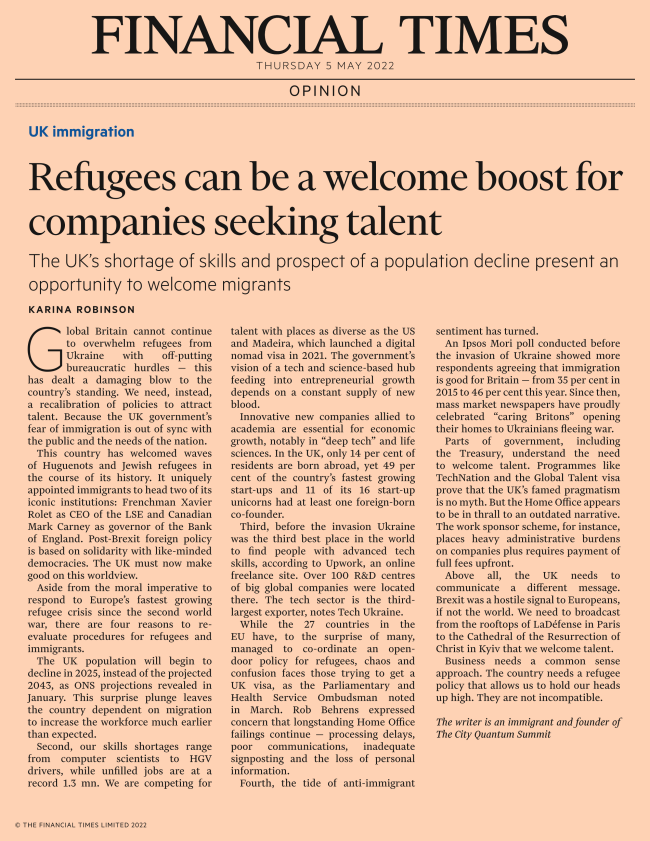
Refugees can be a welcome boost for companies seeking talent
Global Britain cannot continue to overwhelm refugees from Ukraine with off-putting bureaucratic hurdles - this has dealt a damaging blow to the country’s standing. We need, instead, a recalibration of policies to attract talent. Because of UK government’s fear of immigration is out of sync with the public and the needs of the nation.
Overcoming tribal challenges
The most successful species on this planet revels in the comfort of conformity. Just think of the boost and subsequent bonhomie that comes from a ‘successful’ meeting where everyone agrees. Yet with instability as the defining condition of our times, executives must evolve to become comfortable with discomfort.
Who, in the City, would hire someone who had failed a Maths O level? Twice. Yet that is the case of Sir Robert Stheeman, one of the most successful and trusted CEOs of the Debt Management Office, which is responsible for issuing UK government debt. It didn’t seem to affect the £2 trillion – give or take a few billion – that he has issued over 17 years in the job.
The LSE’s new Inclusion Institute
The most successful species on this planet revels in the comfort of conformity. Just think of the boost and subsequent bonhomie that comes from a ‘successful’ meeting where everyone agrees. Yet with instability as the defining condition of our times, executives must evolve to become comfortable with discomfort.
Who, in the City, would hire someone who had failed a Maths O level? Twice. Yet that is the case of Sir Robert Stheeman, one of the most successful and trusted CEOs of the Debt Management Office, which is responsible for issuing UK government debt. It didn’t seem to affect the £2 trillion – give or take a few billion – that he has issued over 17 years in the job.
He is not alone in believing that a contributory factor in the 2008 financial crisis was the increased conformity in the hiring of talent. ECB President Christine Lagarde famously quipped that if Lehman Brothers had been Lehman Sisters the crisis would have looked quite different. Studies from business consultants like McKinsey and respected academic institutions like Harvard Business School conclude that better business decisions result from more diverse and inclusive companies.
And yet how laborious and demanding it is to create this change. The overarching reason is biology. Humans are wired to align individual with group interest, to achieve hyper-sociality, in the words of Mark Pagel, head of the Evolution Laboratory at the University of Reading. Arguably as powerful as the Darwinian natural selection gene is culture, “that software collection of ideas, routines, rituals and behaviours written into our brains – it is the most successful way there has ever been of making more people.”
We are programmed to accept and celebrate the culture of our birth, our tribe, even though it is an arbitrary accident – not to mention the resilience of culturally defined emotions which range from healthy nationalism to xenophobia and racism, notes Pagel.
It is no coincidence that Ursula von der Leyen mentioned Winston Churchill, Soho bars and her discovery of the British sense of humour in the first speech she gave on British ground this year. Titled “Old friends, new beginnings: building another future for the EU-UK partnership,” the EU Commission President reminisced about her time as a student at the London School of Economics, suffusing the room in the warm glow of cultural unity, before delivering the harsh message that “the more divergence there is, the more distant the partnership has to be.”
So how to achieve the cognitive diversity that is necessary to deliver better company returns in a transformed digital marketplace? It is most likely to occur when you mix gender, generation, ethnicity and sexual orientation on boards and teams, and ensure they feel accepted, or included, and thus able to speak up. An uncomfortable meeting is more likely to deliver innovation.
The Financial Services Skills Taskforce report which was published at the end of January was damning of the City’s talent recruitment and retention. Mark Hoban, a former City Minister who chairs the FSST, put it bluntly: “There is no doubt that the financial services sector is facing an existential skills crisis.”
Alarmingly for a sector that depends on talent and innovation, it has the third lowest training spend per employee and the second lowest spend per trainee compared to other sectors of the economy. Meanwhile, fewer than 40% of students associate creativity and a dynamic work environment with working in banks, but highly value these in any future employer.
The demand for talent already exceeds supply and this trend is set to become more acute. “The lack of gender and ethnic diversity is both a social issue and a skills issue. Talent that the industry needs is not being utilised,” argues the independent review commissioned by HM Treasury.
A number of firms are working hard at changing this. Charles Martin, Senior Partner at City law firm Macfarlanes, is clear about the value of hiring a more diverse workforce. “Firstly, it feels right. It doesn’t feel sustainable to work in a market where we don’t look like our clients or the world around us. Secondly, more diversity makes for more balanced decisions and less group think. Thirdly, we need to have the best people working for us. If we are failing in diversity, we will fail in business terms.”
MI5 plans to hire 50% more behavioural scientists in 2020 to help it analyse the vast amounts of online data generated by terror suspects. Marrying psychology and the increasing amounts of data available on diversity and inclusion is just as relevant for City firms.
These are the reasons why, with Associate Professor Grace Lordan, I am co-founding The Inclusion Initiative institute at the London School of Economics. In association with some of the most advanced City institutions we seek to merge data and behavioural science to help change culture for future success.
The City is responsible for well over 10% of the UK’s tax revenues and continues to be one of the global go-to centres for finance. With just a bit of hyperbole, Byron’s lines about the importance of the Coliseum to Rome come to mind: “When falls the City, London shall fall; And when London falls - the World.”
Can I take the opportunity to invite you on the 5th of March at 6pm to come to the LSE and join me for the launch of the Inclusion in the City report, which I am co-authoring with Dr Grace Lordan. This will be a panel discussion event, chaired by Dame Minouche Shafik, and feature four senior leaders from the City of London giving reactions to the messages in the report.
The 5th of March event is ticketed and part of the LSE Festival. This year's Festival will bring together global leaders, innovators and change makers to investigate how we can learn lessons from the past, tackle the challenges of today and shape the future. You can get a free ticket online now by following this link.
It is also the night The Inclusion Initiative will be announced, a new institute at the LSE which I am co-founding. It will bring behavioural science insights to the City of London in partnership with City firms. Do get in touch if your company might be interested in exploring working together. Here is the pamphlet.